In the fashion industry, conversations about trends often mix together signals that operate at very different scales.
Some shifts reflect deep cultural changes that shape the broader context in which fashion evolves.
Others emerge as fast‑moving aesthetic signals circulating through social media and digital culture.
Some shifts reflect deep cultural changes that shape the broader context in which fashion evolves.
Others emerge as fast‑moving aesthetic signals circulating through social media and digital culture.
“Not all fashion signals operate at the same scale — and understanding that difference changes how brands make decisions.”
Understanding the difference between these signals is not simply a matter of terminology.
It influences how brands interpret change, make strategic decisions and build collections that remain relevant over time.
At the most fundamental level, the distinction between macro trends and micro trends is about scale.
They emerge from different sources, move at different speeds and carry very different strategic weight.
Macro Trends
Macro trends represent long‑term cultural shifts.
They develop under the influence of social change, technological transformation and collective experience.
Macro trends rarely appear directly in clothing.
They first emerge within the broader cultural context and only later begin to surface in fashion.
One of the macro shifts shaping contemporary fashion today is Sensory Safety.
This shift reflects a growing desire for emotional reassurance, tactile comfort and a sense of protection.
In a world defined by information overload, instability and constant digital exposure, aesthetics that communicate softness, calm and protection are becoming increasingly relevant.
Macro trends do not dictate specific garments.
Instead, they shape the broader aesthetic direction within which designers and brands begin to operate.
They develop under the influence of social change, technological transformation and collective experience.
Macro trends rarely appear directly in clothing.
They first emerge within the broader cultural context and only later begin to surface in fashion.
One of the macro shifts shaping contemporary fashion today is Sensory Safety.
This shift reflects a growing desire for emotional reassurance, tactile comfort and a sense of protection.
In a world defined by information overload, instability and constant digital exposure, aesthetics that communicate softness, calm and protection are becoming increasingly relevant.
Macro trends do not dictate specific garments.
Instead, they shape the broader aesthetic direction within which designers and brands begin to operate.

Micro Trends
Micro trends operate on a different scale.
They are shorter‑term aesthetic signals that spread through social media, digital culture and visual platforms.
Micro trends can manifest in:
• silhouettes
• materials
• styling details
• recognizable visual codes
They travel far more quickly than macro trends and often generate short‑term waves of visibility and demand.
However, micro trends are not necessarily superficial.
They can serve as early indicators of how deeper cultural shifts begin to express themselves visually.
Macro trends establish long‑term direction.
Micro trends create movement within that direction.
They are shorter‑term aesthetic signals that spread through social media, digital culture and visual platforms.
Micro trends can manifest in:
• silhouettes
• materials
• styling details
• recognizable visual codes
They travel far more quickly than macro trends and often generate short‑term waves of visibility and demand.
However, micro trends are not necessarily superficial.
They can serve as early indicators of how deeper cultural shifts begin to express themselves visually.
Macro trends establish long‑term direction.
Micro trends create movement within that direction.
“Macro trends shape long-term direction.
Micro trends create movement within that direction.”
A System of Signals
To understand fashion trends, it is important to see not individual aesthetics but the system of signals in which they appear.
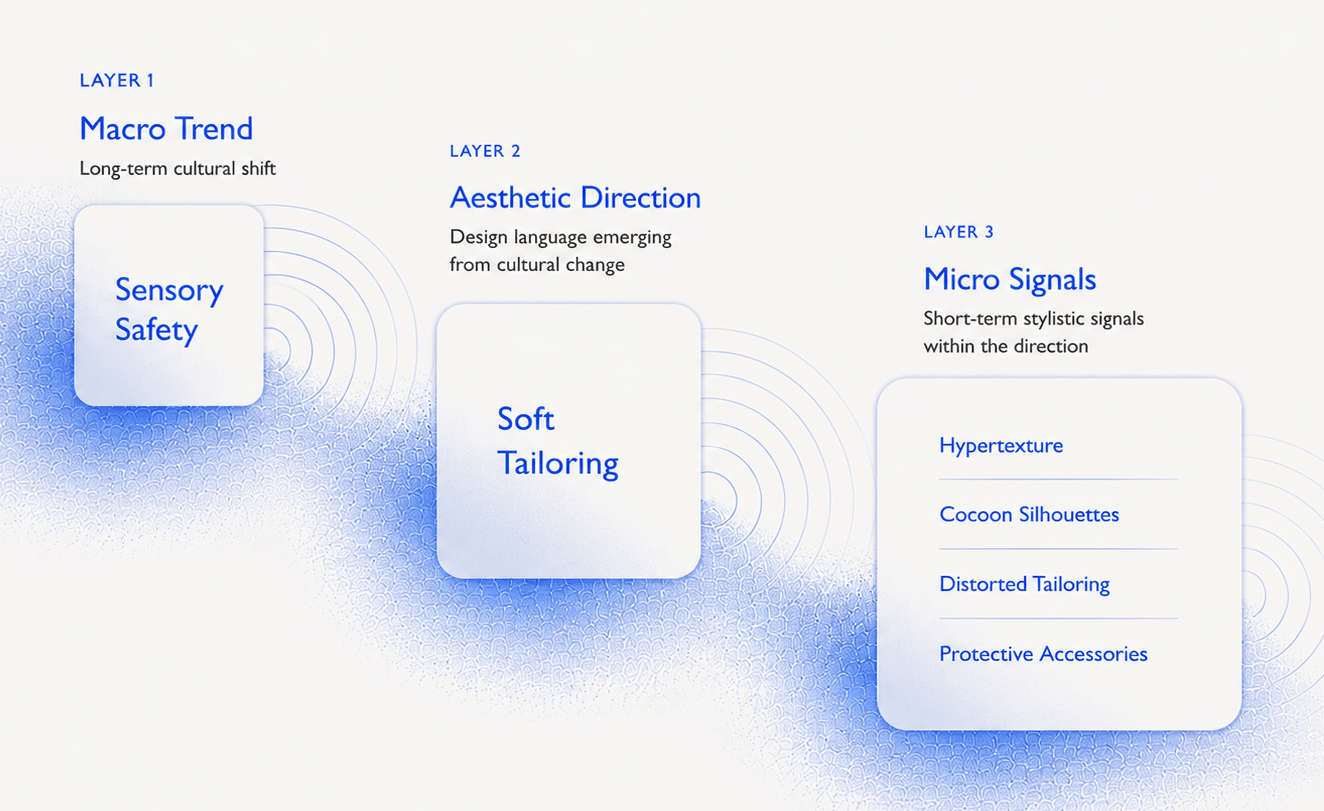
Within the Trend Tailor analytical framework, we examine several layers of signals:
Within the Trend Tailor analytical framework, we examine several layers of signals:
- Macro Trends — long‑term cultural shifts shaping the broader context of fashion.
- Aesthetic Directions — design languages through which cultural change becomes visible in fashion.
- Micro Signals — short‑term stylistic signals that emerge within these directions.
These layers do not form a strict hierarchy.
Instead, they operate as a dynamic system in which different signals interact and reinforce one another.
Instead, they operate as a dynamic system in which different signals interact and reinforce one another.
Need a more structured approach to trend direction?
Trend Tailor helps fashion brands identify emerging cultural signals, aesthetic directions and commercially relevant product shifts.
Analytical Framework
Within our analytical system we track the movement of 95 aesthetic directions across digital visual culture.
The goal is not simply to catalogue styles.
We analyze how the intensity of signals changes over time — which aesthetics begin to appear more frequently, which fade, and which start to emerge.
This approach allows us to detect shifts earlier and evaluate the strategic weight of signals
The goal is not simply to catalogue styles.
We analyze how the intensity of signals changes over time — which aesthetics begin to appear more frequently, which fade, and which start to emerge.
This approach allows us to detect shifts earlier and evaluate the strategic weight of signals
“Trend analysis is not only about identifying what appears.
It is about understanding which signals are gaining strategic weight.”
Example: An Aesthetic Direction within a Macro Trend
One aesthetic direction within the Sensory Safety macro trend is Soft Tailoring.
Soft Tailoring reinterprets the language of classic tailoring through the lens of comfort and softness.
Typical visual expressions include:
• relaxed silhouettes
• softened blazer structures
• tactile fabrics
• calm, muted color palettes
This aesthetic reflects a broader cultural movement toward emotional comfort and sensory reassurance.
Soft Tailoring reinterprets the language of classic tailoring through the lens of comfort and softness.
Typical visual expressions include:
• relaxed silhouettes
• softened blazer structures
• tactile fabrics
• calm, muted color palettes
This aesthetic reflects a broader cultural movement toward emotional comfort and sensory reassurance.
Micro Signals within this Direction
Within this aesthetic field several micro signals are emerging:
- Hypertexture — highly tactile materials and complex surfaces.
- Cocoon Silhouettes — enveloping shapes that create a sense of softness and protection.
- Distorted Tailoring — subtle shifts and distortions of traditional tailoring lines.
- Protective Accessories — accessories that visually emphasize protection and layering.

These signals do not exist in isolation.
They appear as visible expressions of deeper cultural processes.
They appear as visible expressions of deeper cultural processes.
Signal Mapping
Conclusion
Fashion evolves not through isolated trends but through a system of signals operating at different scales.
The key task for brands is therefore not simply to follow trends but to understand their scale and strategic weight.
Macro trends shape the long‑term cultural context.
Aesthetic directions translate that context into design language.
Micro signals create visible momentum within these processes.
Brands that understand how these levels interact — and align them with their own identity — are far better positioned to navigate an increasingly complex fashion landscape.
The key task for brands is therefore not simply to follow trends but to understand their scale and strategic weight.
Macro trends shape the long‑term cultural context.
Aesthetic directions translate that context into design language.
Micro signals create visible momentum within these processes.
Brands that understand how these levels interact — and align them with their own identity — are far better positioned to navigate an increasingly complex fashion landscape.
Need a more brand-specific approach to trend direction?
Trend Tailor helps fashion brands identify cultural signals that align with their audience, aesthetic positioning and long-term product strategy.
Continue Reading

When Intuition Stops Being Enough for Fashion Brands
The moment trend intelligence becomes essential for product decisions.
The moment trend intelligence becomes essential for product decisions.

Why General Fashion Trends No Longer Work
How niche communities and aesthetic identity are reshaping the fashion landscape.
How niche communities and aesthetic identity are reshaping the fashion landscape.